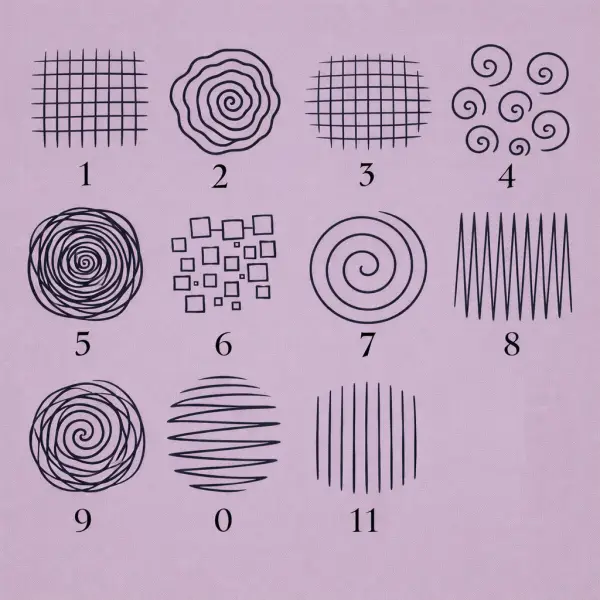
Table of Contents
- Drawing 0: anxiety from blurred boundaries
- Drawing 1: anxiety from demand and need for control
- Drawing 2: emotional anxiety and high sensitivity
- Drawing 3: anxiety in the face of chaos and lack of structure
- Drawing 4: anxiety from stimulus overload
- Drawing 5: intense, deep, and enveloping anxiety
- Drawing 6: anxiety from fragmentation and excessive analysis
- Drawing 7: mental anxiety, rumination and anticipation
- Drawing 8: anxiety with internal spikes of tension
- Drawing 9: anxiety with hypervigilance
- Drawing 11: anxiety from rigidity, confinement and lack of mental space
Follow Patricia Alegsa on Pinterest!
This is not a clinical test and does not replace a psychological evaluation. But note: the image that attracts or bothers you the most can show how your anxiety moves. And that already says a lot.
In my practice I see the same thing again and again: many people don’t say “I have anxiety.” They say “I overthink,” “I need to control everything,” “I can’t stop my head,” “I’m exhausted inside” or “I tense up for anything.” The wording changes, but the pattern is usually the same.
Anxiety does not always arrive as an obvious panic. Sometimes it takes the form of perfectionism, constant alertness, mental saturation, emotional fatigue, or a need for order. That’s why this visual exercise can be so interesting: you’re not asking the rational mind, you’re asking your immediate reaction.
Look at the main image of the article and choose one of the drawings without thinking too much. Don’t look for the prettiest, the strangest, or the most “correct.” Just notice which one stirs something inside you: curiosity, rejection, tension, discomfort, or that strange feeling of “this one hits me.”
- Choose quickly. If you analyze it too much, your mind starts “cheating.” And on that, it already has a PhD.
- Stick with your first reaction. It’s usually the most honest.
- If you hesitate between two drawings, choose the one that moved you more intensely.
Now then. Find the number of the drawing you chose and discover what type of anxiety usually accompanies you.
Drawing 0: anxiety from blurred boundaries
If you chose 0, your anxiety usually grows when everything blends together. Thoughts, emotions, responsibilities, noise, other people’s demands, your own pending tasks... everything comes in at once and your internal system loses clarity.
You don’t always lack strength. Many times you have too much load. Your mind tries to hold too many things at once and ends up unable to distinguish what’s urgent, what’s not, what belongs to you and what doesn’t. Then that feeling of total saturation appears, as if everything invades everything.
I see it this way: your anxiety doesn’t arise only from excess; it also comes from the lack of edges. When you don’t set boundaries, your interior becomes a room without doors.
What usually helps: separating tasks, reducing stimuli, setting clear limits, turning off notifications, saying “not now,” and reclaiming small spaces of mental silence.
Drawing 1: anxiety from demand and need for control
If you chose 1, your anxiety usually comes from self-demand. You need order, logic, control, and the feeling that everything fits. When something goes off plan, your mind doesn’t rest: it wants to fix it now, all at once and perfectly.
This pattern appears often in responsible, dutiful, and highly committed people. From the outside you may seem strong and organized. Inside, however, you live under constant pressure. You don’t allow much margin for error and that wears you down.
When something gets out of place, you don’t just see a problem. Your mind sees ten possible consequences, twenty details to correct, and an internal alarm shouting “do something now.” It’s exhausting, I know.
What usually helps: lowering the demand, prioritizing, accepting that “good enough” is often better than “perfect,” and remembering that controlling everything doesn’t bring peace; it only gives you scheduled exhaustion.
Drawing 2: emotional anxiety and high sensitivity
If you chose 2, your anxiety usually moves in the emotional realm. You feel a lot, perceive a lot, and absorb easily what happens around you. Sometimes you carry things that didn’t even start in you.
When someone close is unwell, your body notices. When the atmosphere changes, you register it quickly. When something hurts, it hits you deeply. That sensitivity is not a flaw. In fact, it can be a great strength. The problem appears when you can’t put distance between what you feel and what others feel.
Then your anxiety grows like a soaked sponge. You accumulate emotion, tension, worry, and internal fatigue until you no longer know which part of the discomfort is yours.
What usually helps: naming what you feel, differentiating “this is mine” from “this belongs to the other,” setting emotional boundaries, and giving yourself breaks to unload before you saturate.
Drawing 3: anxiety in the face of chaos and lack of structure
If you chose 3, your anxiety usually activates when you perceive chaos, disorder, or lack of direction. You need to know where each piece is, what comes next, what’s due now, and where everything is heading.
When you can’t find structure, your mind goes on alert. Not because you’re rigid out of caprice, but because disorder makes you feel insecure. If you don’t see clarity, your head tries to create it by force.
That can lead you to over-organize, over-check, or overthink. Your internal system searches for a sense of map. And when it doesn’t find it, it tenses up.
What usually helps: breaking big things into simple steps, creating basic routines, visualizing priorities, and focusing on the next action, not trying to solve everything at once.
Drawing 4: anxiety from stimulus overload
If you chose 4, your anxiety usually appears when there are too many things at the same time: tasks, ideas, messages, to-dos, noise, interruptions, conversations, decisions. Your mind doesn’t fail. Your mind gets saturated.
I want to underline something important: this doesn’t mean weakness. It means overload. There are days when the brain receives so much that it no longer processes clearly. Then irritability, tiredness, difficulty concentrating, or the feeling that everything overwhelms you appear.
Many people with this pattern believe they “should be able to handle everything.” And that’s where the cruel circle starts: more pressure, more saturation, more anxiety. A perfect deal... but for discomfort.
What usually helps: doing one thing at a time, lowering exposure to screens and noise, emptying pending tasks onto paper, and giving yourself real breaks—not those “rests” where you keep scrolling as if you were paid to suffer.
Drawing 5: intense, deep, and enveloping anxiety
If you chose 5, your anxiety is usually experienced very intensely. When a thought traps you or an emotion hits you, it’s hard to get out. You don’t live it on the surface; you live it inwardly, with depth.
This pattern can lead to long mental or emotional loops. You go over something, feel it strongly, think about it again, relive it, and end up stuck in the same circuit. Your mind doesn’t let go easily and your body notices it.
Intelligence and introspection are usually not lacking here. Sometimes, in fact, there’s an excess. You think so deeply and feel so strongly that the anxiety becomes enveloping, almost like a thick fog.
What usually helps: breaking the loop through the body, not just thought. Walking, breathing with rhythm, talking to someone, writing what you feel, and cutting the rumination before it swallows you whole.
Drawing 6: anxiety from fragmentation and excessive analysis
If you chose 6, your anxiety usually appears when everything breaks into too many parts. You analyze, observe, think, dissect, compare... and it reaches a point where you don’t know where to start.
You don’t lack ability. You have excess processing. Your mind tries to understand every detail before moving forward and that ends up creating blockage. You see so many variables that any decision feels huge.
Many people with this pattern feel that if they found “the right way,” they could finally move. But anxiety doesn’t always ask for a brilliant answer. Sometimes it asks for a simple first step.
What usually helps: stopping trying to solve the whole puzzle, choosing a single entry point, writing concrete options, and moving forward with what’s possible, even if it’s not perfect or final.
Drawing 7: mental anxiety, rumination and anticipation
If you chose 7, your anxiety lives mainly in the mind. You go in circles, anticipate scenarios, imagine conversations, review what you said, what you could have said, and what you might say tomorrow at 6:40 p.m. Yes, the head can be exhausting.
Not always does something serious happen outside you. Sometimes the main problem happens inside: your mind can’t find the brake. It jumps from one possibility to another, builds hypotheses, tries to foresee everything, and ends up lighting alarms in advance.
This pattern often gives the feeling of “never fully resting.” Even when nothing is happening, your system keeps working as if a threat were on the way.
What usually helps: noticing when thinking no longer helps, limiting rumination time, bringing attention to the present, and remembering that anticipating is not the same as controlling.
Drawing 8: anxiety with internal spikes of tension
If you chose 8, your anxiety usually rises and falls strongly. You may appear calm on the outside, but inside you experience sudden waves of tension, urgency, or overwhelm.
This pattern is puzzling because sometimes not even you understand why you went from feeling fine to having such a sharp internal spike. Your system seems to activate suddenly and then subside, as if it had a capricious switch.
In reality, there are almost always early signs: accumulation, tiredness, stored emotions, excess stimuli, or sustained stress. The problem isn’t that it appears “out of nowhere”; the problem is that you notice it late.
What usually helps: identifying your early signals, regulating breaks, taking care of sleep, not ignoring bodily tension, and slowing down before the spike, not after.
Drawing 9: anxiety with hypervigilance
If you chose 9, your anxiety usually mixes with hypervigilance. Your mind scans the environment, detects changes, reads signals, interprets tones, observes details, and looks for problems before they arise.
This pattern often comes from the need to protect yourself. Your system learned that anticipating gives security, so it stays on alert. The problem comes when that alert never goes down. Then you live with tiredness, tension, difficulty relaxing, and a constant feeling of “I have to stay on guard.”
From the outside, this style may look like efficiency or intuition. And yes, sometimes you notice things others don’t. But the internal cost can be high: your body never fully rests because it’s always expecting something.
What usually helps: teaching the body that not everything requires an immediate response, reducing overexposure to stimuli, practicing moments of real safety, and letting go of the idea that you only survive by foreseeing everything.
Drawing 11: anxiety from rigidity, confinement and lack of mental space
If you chose 11, your anxiety usually appears when you feel rigidity, pressure, or confinement. You need margin, mental space, air, flexibility. When everything becomes too straight, too fixed, or too imposed, you tense up.
This pattern appears often in creative people, those sensitive to pressure, or those strongly affected by rigid environments. If you feel you can’t move, choose, improvise, or breathe mentally, your system responds with discomfort and anxiety.
You don’t always reject structure. You reject the structure that squeezes you. There’s a big difference. One thing is to support you. Another is to suffocate you.
What usually helps: regaining autonomy, introducing small options, taking breaks, loosening expectations, and giving yourself permission not to live inside a mold that’s too small for you.
One last idea: this exercise doesn’t label your personality or define your whole story. It only illuminates the place where your anxiety usually grabs on most strongly. And that already helps a lot, because when you understand the pattern, you stop fighting it blindly.
If a description really touched you, don’t take it as a sentence. Take it as a clue. Anxiety loses power when you learn to recognize what activates it, how it speaks to you, and what it needs from you to decrease.
Important: if your anxiety affects your sleep, your body, your relationships, your work, or your daily wellbeing, seek professional help. You don’t need to wait until rock bottom to start taking care of yourself.