Table of Contents
- Who Marcus Aurelius was and why his reflection remains relevant
- What it means that happiness depends on the quality of your thoughts
- Relationship between Stoicism and modern psychology
- How to apply Marcus Aurelius’ ideas in adverse situations
- What I’ve seen in therapy and talks about mental self-control
Follow Patricia Alegsa on Pinterest!
In times of anxiety, screens on all day and thoughts popping like popcorn 🍿, an idea written almost two thousand years ago still sounds surprisingly current: “The happiness of your life depends on the quality of your thoughts”.
The phrase is attributed to Marcus Aurelius, Roman emperor and a reference figure of Stoicism. And no, he didn’t write it while calmly sipping coffee watching the sunset 😅. He wrote it amid wars, disease, political tensions and enormous responsibilities. Precisely for that it resonates so strongly today: it speaks of mental balance when life tightens its grip.
As a psychologist, writer and speaker, I’ll tell you something I see again and again: many people don’t suffer only because of what happens to them, but because of what they tell themselves about what happens to them. There Marcus Aurelius keeps winning modern debates without raising his voice.
Who Marcus Aurelius was and why his reflection remains relevant
Marcus Aurelius was born in Rome in 121 and ruled the Empire from 161 to 180. He lived through a harsh era: military conflicts, epidemics and internal crises. In other words, he didn’t exactly live in “premium wellness” mode 😌.
Still, he became one of the most remembered figures not only for his political and military role, but for his philosophical life. He was linked to Stoicism, a current that teaches distinguishing between what depends on you and what does not.
During the hardest years of his life he wrote Meditations, a kind of personal diary in Greek where he gathered ideas about virtue, inner discipline and governance of the mind. According to the Stanford Encyclopedia of Philosophy, that work ended up becoming one of the most influential texts in Western philosophy.
And here’s a curious fact 📚: Marcus Aurelius didn’t write that book to become famous. It wasn’t a self-help manual to sell at airports. They were notes to himself, exercises in inner vigilance. Maybe that’s why they move us so much: they sound honest, sober and human.
His famous idea about happiness and thoughts sums up the core of his proposal: the mind doesn’t always control what happens outside, but it can learn to order what happens within.
What it means that happiness depends on the quality of your thoughts
When Marcus Aurelius states that the happiness of your life depends on the quality of your thoughts, he’s not saying you should smile all the time or repeat pretty phrases in front of the mirror like a toothpaste ad 😄.
What he proposes is deeper: your way of thinking influences your way of living. If you feed destructive, exaggerated or irrational ideas, your inner world becomes more hostile. If you train clearer, fairer and sober thoughts, you gain serenity.
According to compilations like those from FixQuotes, the full phrase adds an important warning: it’s wise to watch the ideas you welcome into your mind so you don’t fill it with notions that pull you away from virtue and reason.
That seems brilliant to me because Marcus Aurelius doesn’t speak only about feeling good. He speaks about thinking well. And thinking well implies:
- not dramatizing automatically
- not confusing an emotion with a fact
- not reacting immediately to everything
- not handing over your peace to external factors
In simple terms, the Roman emperor is telling you something like: “mind your inner dialogue, because that’s where your wellbeing is cooked”.
And here comes an uncomfortable truth: sometimes the mind acts like an exaggerated commentator. You give it a small worry and it produces a five-season tragedy. That’s why mental self-control isn’t a luxury, but a necessity.
Relationship between Stoicism and modern psychology
If this idea sounds modern to you, don’t be surprised. contemporary psychology found very fertile ground in several Stoic intuitions.
The American Psychological Association explains that cognitive behavioral therapy works on a well-known basis: thoughts influence emotions and behavior. In other words, not only what happens matters, but how you interpret it.
That line connects directly with Stoicism. Epictetus, a major influence on Marcus Aurelius, already insisted that things do not disturb us by themselves, but by the opinion we form about them.
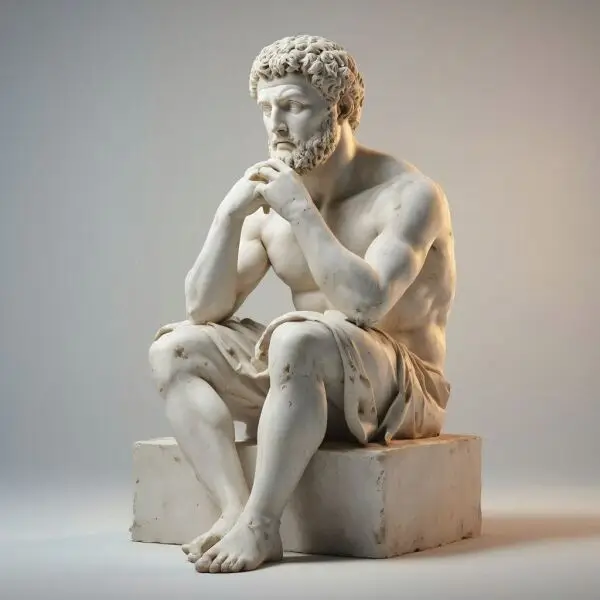
Donald Robertson, in How to Think Like a Roman Emperor, explains precisely that union between ancient philosophy and current psychological tools. His reading helps to understand that Marcus Aurelius wasn’t proposing repressing emotions like a marble statue 🏛️. He proposed examining the mental interpretation before reacting.
From my clinical work, this connection is very clear. Many times a person comes saying:
- “I can’t handle this”
- “Everything goes wrong for me”
- “If something went wrong today, my whole week is ruined”
When we review those phrases, we find very familiar cognitive distortions:
- catastrophizing
- all-or-nothing thinking
- overgeneralization
- negative filtering of reality
There Marcus Aurelius pokes his head in and says, with Roman elegance: “observe better what you are thinking”.
The fascinating thing about his legacy is that it moves happiness off the ground of chance. He doesn’t leave it in the hands of the weather, the economy, others’ approval or the day’s chaos. He links it to inner order, the rectitude of judgment and mental training.
How to apply Marcus Aurelius’ ideas in adverse situations
The big question isn’t only what Marcus Aurelius thought, but how you can use it when life gets complicated. Because reading inspiring phrases is fine, but your mind needs practice, not just applause 👏.
These tools work very well when you feel stress, anger, fear or frustration:
- Separate facts from interpretation
Question: what actually happened and what part did I add with my assumptions? - Review your inner dialogue
If you catch yourself thinking “this is unbearable,” try “this is difficult, but I can handle it step by step.” - Return to what depends on you
You don’t control traffic, others’ opinions or the past. You do control your response, your habits and your present decisions. - Write your thoughts down
Marcus Aurelius did. And he was right. Writing clarifies, orders and lowers mental noise. - Practice the pause
Breathe before responding. A brief pause prevents many emotional disasters and several messages you later regret 📱. - Look for thoughts compatible with reality and dignity
It’s not about lying to yourself, but about thinking with more accuracy and less poison.
I’ll leave you a simple exercise, very useful in adverse moments:
- Situation: what is happening?
- Automatic thought: what am I telling myself?
- Emotion: what do I feel?
- Review: is that thought completely true?
- New response: what fairer, more rational and useful idea can I choose?
This approach doesn’t eliminate human pain. It makes it more manageable. And that already changes a lot.
What I’ve seen in therapy and talks about mental self-control
In therapy I’ve worked with people trapped by a silent enemy: their own internal narrative. I’m not talking about superficial cases, but about bright, sensitive, hardworking people who spoke to themselves with crushing harshness.
I remember a patient who kept repeating: “If I fail, I disappoint everyone”. That single idea stole her sleep, energy and self-esteem. When we began to question it, something revealing appeared: she wasn’t describing reality, she was obeying an old internal demand.
There I used a strategy I also mention in my motivational talks: treat your thoughts as hypotheses, not verdicts. That shift seems small, but it transforms the experience.
At another talk I asked the audience: “How many of you speak to yourselves worse than you would to a friend?”. Almost every hand went up. We laughed, of course, because sometimes humor opens the door to uncomfortable truths 😂. But we also understood something important: many people seek peace without reviewing the tone of their inner voice.
I’ve seen that in philosophy readers, patients with anxiety and exhausted professionals. They want to control everything outside, when the real work begins inside.
And here’s my frankest opinion: mental discipline doesn’t make you cold, it makes you free. It allows you not to react impulsively, not to buy into every thought that appears and not to live as a hostage to mental noise.
That’s why Marcus Aurelius’ teaching remains so alive. It doesn’t promise a life without pain. It promises something better: a mind with more order, judgment and strength to go through pain without collapsing.
If you want to start today, try asking yourself this at the end of the day:
- What thought did I feed today that gave me peace?
- What thought did I feed today that took away my clarity?
- Which will I choose to reinforce tomorrow?
It sounds simple, but simple doesn’t mean easy. And that’s the art.
Marcus Aurelius understood something essential: the external world changes, strikes and confuses; the trained mind, on the other hand, can become a refuge, a compass and an inner strength 🌿.
Maybe that’s why his reflection continues to inspire debates about self-control, thought management and emotional balance. Deep down, we’re all still looking for the same thing: to live more calmly without letting the outer chaos entirely govern the inner one.