Table of Contents
Follow Patricia Alegsa on Pinterest!
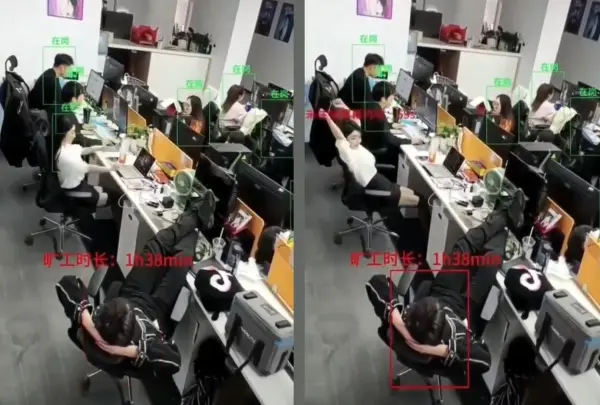
A video recently shared on social media has sparked controversy by showing how a Chinese company allegedly uses artificial intelligence to monitor its workers.
The footage shows an office with several people sitting at their computers. At the same time, a facial-recognition-based system appears to record when each employee is working and when they take a break.
The technology would make it possible to identify movements and calculate how long each worker remains at their workstation, as well as flag their breaks. Everything would happen automatically and almost instantly.
Is the AI workplace surveillance video real?
The video associated with this article went viral within a few hours. However, it is still not known for certain which company appears in the footage.
Nor has it been confirmed whether the system is actually in operation, whether it is a technology demonstration, or whether the content was created to attract attention on social media. For this reason, it is best to view it cautiously and avoid drawing definitive conclusions without further information.
Artificial intelligence, productivity, and employee privacy
Artificial intelligence can help organize tasks, identify repetitive processes, and improve certain aspects of productivity. The problem arises when that efficiency turns into constant surveillance and excessive control.
Recording every break, movement, or moment of inactivity raises important questions about privacy. It also requires us to consider who can access that data, how long it is retained, and how it could be used to assess or penalize a person.
Is it necessary to monitor employees' time so precisely? What effect could this surveillance have on their emotional well-being, autonomy, and way of working?
How constant surveillance can affect people at work
Speaking for the article, labor relations expert Susana Santino pointed out that these kinds of practices can foster a toxic work environment, marked by mistrust and a lack of autonomy. As she explained, this dynamic could affect employees' motivation and commitment.
“If they feel constantly watched and controlled, their performance and creativity are likely to suffer,” Santino added.
In everyday life, a person who feels that every gesture is being measured may end up paying more attention to the system than to their own task. Even a brief pause to drink water, rest their eyes, or think of a solution could be experienced with tension.
Technology is not necessarily the problem. The difference lies in how it is implemented. Transparency, clear boundaries, and respect for privacy are essential to prevent a digital tool from becoming a source of pressure.
For now, no further details have emerged about the origin of the video or the company allegedly using this system. Even so, the images have already opened up a necessary conversation: how far technological control in the workplace can go, and what boundaries should protect people.
Using AI to monitor employees' productivity in China.pic.twitter.com/6YXY3oSiZY
— Massimo (@Rainmaker1973) May 10, 2024