Table of Contents
Follow Patricia Alegsa on Pinterest!
We live in a world that seems to be moving forward at full speed. More and more aspects of our lives are automated or depend on artificial intelligence (AI).
We use it to communicate, work, study, find an address, choose a movie, or answer a question. It can even create images, write texts, and analyze large amounts of information in just seconds.
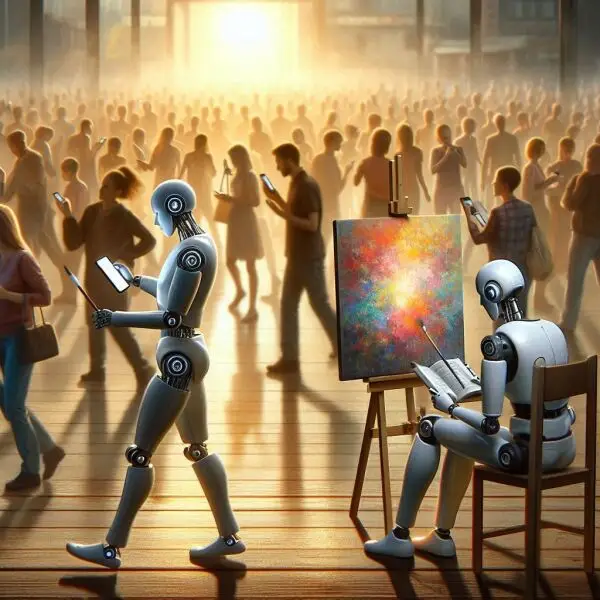
AI has become an everyday presence. But its growth raises an uncomfortable question: does this technology help us think better, or does it get us used to not thinking?
In many ways, it makes our lives easier. Who has not ordered food, paid a bill, or found the quickest route without leaving the couch? That convenience is real and can save us time. However, it also comes at a cost when we stop reviewing, questioning, or making decisions on our own.
The problem is not using smart tools. It arises when we use them as permanent substitutes for our memory, creativity, and problem-solving skills. If an app always calculates, writes, remembers, and chooses for you, some abilities may get less practice.
Dependence on artificial intelligence: where the real risk lies
One of the biggest challenges is finding a balance between taking advantage of AI and becoming too dependent on it. You do not need to reject technology, but you do need to maintain an active role.
Think of something as commonplace as clicking “Accept All.” We often do it in a hurry, without reading what data we are sharing or what permissions we are granting. In doing so, we hand over small decisions to systems we do not always understand.
Something similar happens when we accept an automated answer as though it were beyond question. AI can make mistakes, invent facts, leave out context, or reproduce biases. That is why it is a good idea to verify information and turn to trustworthy sources, especially when facing important decisions.
At work and in education, tools such as ChatGPT can help organize ideas, spot mistakes, or explore alternatives. But copying an answer without understanding it does not represent real learning. Some companies and universities have chosen to limit these tools in order to encourage independent thinking. Even so, banning them completely may not be the only solution. Teaching people to use them wisely may be more helpful in the long run.
If you are concerned about how technology affects your attention, this article on social media, mental health, and the so-called “brain rot” may also guide you.
The future of artificial intelligence and human thought
It is difficult to predict what the coming decades will look like. What does seem clear is that our relationship with AI will continue to evolve and require new skills.
Some people imagine a future in which machines vastly surpass certain human abilities. Others fear a world ruled by robots. These possibilities spark important debates, but there is no need to approach them from a place of panic.
AI already outperforms people at specific tasks, especially when it needs to process data or repeat operations. But human intelligence includes much more: empathy, experience, responsibility, intuition, ethical judgment, and the ability to understand nuances.
The most constructive scenario is not a constant competition between humans and machines. It is a relationship in which technology complements our abilities without replacing our judgment. To explore this transformation further, you can read about the advances through which machines are surpassing some human skills.
How to use artificial intelligence without giving up thinking
These habits can help you maintain a healthier, more mindful, and productive relationship with technology:
- Unplug from time to time. Set aside moments to read, write by hand, talk, cook without tutorials, or solve a puzzle. It is not about punishing technology, but about exercising other abilities.
- Think before you ask. Try to come up with your own answer first, then compare it with the AI’s response. This small exercise strengthens your judgment and keeps you from automatically adopting someone else’s ideas.
- Verify information. Look for the original source, check dates, and compare claims. A convincing answer is not always a correct one.
- Use it as an assistant, not as the pilot. At work, it can help you organize, summarize, or explore options. The final decision, especially if it affects other people, must remain under human oversight.
- Protect your privacy. Avoid sharing personal data, passwords, confidential documents, or sensitive information in tools whose workings you do not know.
- Demand ethics and transparency. Support technological development that respects privacy, explains its limitations, and makes it possible to identify when someone is interacting with an automated system.
It is also important to listen to how you feel. If you notice overwhelm, anxiety, or difficulty concentrating, taking a break may help. I suggest reading these methods for fighting the stress of modern life.
Artificial intelligence and autonomy: finding a healthy balance
Our growing reliance on AI is a double-edged sword. It can make tasks easier, broaden access to knowledge, and free up time. It can also make us passive if we accept every result without analyzing it.
We are not less intelligent for using technology. The risk arises when we give up asking questions, creating, remembering, debating, and making mistakes. These experiences are part of learning and should not become functions that are entirely delegated.
The next time a tool gives you an instant answer, try asking yourself three questions: “Does this make sense?”, “Where does this information come from?”, and “What do I think?” That brief moment of reflection can make a big difference.
AI will continue to be present. The real challenge will be using it without handing over our curiosity or our ability to choose. Do you use it to enhance your ideas, or do you notice that sometimes it ends up thinking for you?